Monday, September 23, 2013

Incubator Classroom at Conversations in Celebration of Teaching

Incubator Classroom at Conversations in Celebration of Teaching


On Friday (Sept 20), I participated in Auburn University's first Conversations in Celebration of Teaching, an internal conference allowing faculty to showcase how they are using new methods in their teaching.  This year's focus was definitely on the e-portfolio, with lots of posters on assessment, rubrics, assignments.  However, some of the posters covered other aspects of innovative teaching as well, such as flipping the classroom or taking an introductory Spanish course completely online.

I was invited to participate as one of the supporting units, focusing on the Incubator Classroom.  My oldfashioned poster brought some interested folks to my table, so I am hoping that I will get more of the word out and more faculty interested in teaching in this kind of setting.
Poster at Conversation in Celebration of Teaching.

Wednesday, September 18, 2013

First meeting of Faculty -- Feedback and Exchange of Ideas

We had our first meeting of the faculty who are teaching/going to teach in the new classroom space for feedback and an exchange of ideas.
The first few minutes were dedicated to issues with the room -- the consensus is that the teaching station needs to move into the corner, and that this would not create the illusion of a front of the room but instead will improve site lines and possibly remove the teacher from the center of activity (which is still perceived as a position of privilege).  Some reports on the touch screen -- apparently buttons are preferred rather than a touch screen that allows for more flexibility.
One interesting point about the glass boards -- glare is an issue, though that is controlled through the dimmable lights.  And of course the monitor size and height.

Positive feedback:
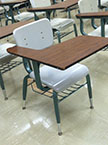
traditional table chair

Steelcase chairs
Students have commented on the chairs as being very comfortable, especially in comparison to our regular tablet chairs.

They also like the amount of work space on the tables, although the orange table is not that popular.


Faculty exchanged ideas about what they were doing in the classroom, including gallery walks, role playing, individual and group assessment to measure the level of preparedness, negotiation of assignments between groups and faculty and within groups.  One recurrent theme was that this rooms allows for the application, practice of learned concepts -- whether this is in reading education, game theory, or health administration.
Students love that they can work on their projects in class, with the help of others and immediate access to the faculty member.  When students work on the glass boards or use the monitors to work on their projects, one additional effect is that other groups see what the level of presentation is and rise to the challenge -- the design, complexity, and depth of student work appears to increase.

Friday, September 6, 2013

Incubator Classroom: Two weeks in!

Incubator Classroom:  Two weeks in!


The incubator classroom has its first two weeks completed, and I keep getting feedback from faculty and, more second hand, from students.  In addition, now we have ten courses scheduled in the room (up from the original seven).

We need to work on the height of the monitors -- they need to come a good bit lower, so we are going to start with one and see if just a few inches is enough of a difference or if we need to be more radical -- maybe think about a swivel arm that will get the monitors further down.

We need to work on the noise level of the equipment -- hopefully, when the cabinet furniture finally arrives, that issue will be contained.

Faculty are concerned with students not paying attention to their classmates when others are talking - so, either faculty need to set clearer boundaries and/or student groups need to use the microphone to get though to the other groups who are busily working away on their own project.

Undergraduate students in particular like the colors of the space -- graduate students not so much -- and a large group of faculty entering the room is quite the experience in terms of what comments they come up with.

Question -- is there some good color evaluation theory out there that can be used as the basis for evaluating color in the space?


Friday, August 30, 2013

Sustainability in the Classroom

Sustainability in the Classroom


Today, I worked on a survey for students to evaluate the active learning space - I do need to come up with a better name for these kinds of spaces here at Auburn University -- happy to hear suggestions.

For other information -- I heard back from the Interior Designer who worked with me on this project -- she sent me data on sustainability of the furniture and carpet in the room.  Here some of that information:

Interface is the company we got the carpet from, and their information on recycled materials and such can be found at https://www.interfaceflor.com/default.aspx?Section=2&Sub=3&Ter=3.

Please also see the links below for environmental info about the furniture products


Also, because the glassboards last much longer and perform better than whiteboards, we are saving lots of whiteboards from being landfilled after end-of-life. The glassboards will last the life of the building and be able to be moved to any future building—and will still keep on performing!

So, that may not make this room LEED certified (it is, after all, in the building on campus that had the first air conditioning on campus, which, unfortunately translates now into one of the more ineffective systems on campus), but it is good to see that today's companies take these challenges seriously.

Thursday, August 22, 2013

Incubator classroom, Day 2

Well, it looks like we may have lost one class because the monitors are too high up and/or too small, so statistical procedures and problems are too difficult to read.  We have started the discussions on how to adjust the monitor locations so that this is less of an issue.

Clickshare USB deice, aka hockey puck
In case you were wondering what I meant by Clickshare -- this is the device that plugs into laptops so that students can connect their laptops to the monitors.  The corresponding app allows for iOS and Android devices to do the same thing, although the laptop sharing is more flexible.

Wednesday, August 21, 2013

Incubator Classroom

Today is the big day -- classes are starting in the incubator classroom here at Auburn University.  Last night, the almost final touches were added to it, so that folks will be able to connect via laptop through HDMI and via wireless through Clickshare.

The colors of tables and chairs are really nice, and the touch screen in the room corresponds with the colors of the tables to make the controls hopefully more intuitive.
Incubator Classroom
Faculty have been working in groups to rethink the classes they teach in here, and we will have ongoing discussions this semester how these changes are working, to improve the classroom experience and to help future faculty think about issues.


Tuesday, May 7, 2013

Star date:  5-7-2013

Having just spent a couple of hours reading articles about MOOCs, I am stunned by the voices who worry that the students who sign up for MOOCs, who participate, are not who they say they are.  I know, it comes out of the discussion to give credit for such courses, but what seems to be missing in this discussion is the glory that the tools are there to connect interested people with great content and interactive tools so that they can learn, discuss, create new ideas that otherwise they may not be able to do on their own.  Is this a substitute for the traditional classroom -- not 100%.  Is this a feasible alternative for folks who do not have access to education otherwise -- absolutely.  Is this disruptive innovation -- of course as the folks who have little or nothing now have more than before, and over time these offers will change what is happening in the traditional classroom -- and hopefully for the better.

I am not saying anything new here, obviously.

And completely different -- still trying to MOOC -- and what I am realizing is that while I was fine in the course the first couple of times I went in, the fact that the course did not change, did not, on the surface, reflect my progress, as the home page did not change to reflect that I am at a different moment in time, at a different moment in learning, makes it difficult for me to pick up where I left off.  I am not sure how that can be helped, unless one uses the course stream or the module or syllabus and assignment view.  maybe the first page only needs to be up for a couple of weeks and then it needs to be shifted to a different view to allow for a better reflection of the progression for the student.