While
the small teaching strategies may not seem as small as they are in
Lang's Small Teaching book, a lot of these are scalable - you can start
with one and keep growing.
Key takeaways for me: Instructor
engagement with students is as important as in a face-to-face classroom -
but it has to be better planned because the spontaneous encounters will
not be likely.
Empowering students to increase their motivation is
essential for student success: choice is one way to do this, whether
that is giving options for assignment topics, options on how many
discussion posts need to be written, options on how to work through the
required material, or a segment of the course that is designed by
students.
Transparency in assignment design - students need to
understand why they are asked to work through certain tasks. Students
need to get practice in successful online learning - this may be new for
us, but it is definitely a new environment for most of our students.
Encouragement
- something that can happen quickly in a face-to-face classroom takes
more time and effort in an online class - be an online cheerleader.
Here some more details:
1. Because we are more likely to start an online class from scratch, using backward design principles will pay off to focus on the learning objectives and outcomes, how they are connected to the assignments, and the assignments to learning activities, and these to the online resources. One point to remember here is that students may not only need to learn the content but also the tools to access, process, and create - so giving them opportunities to practice in a scaffolded environment what they are learning is essential, but also giving them opportunities to practice with the tools that will be used to create and submit high stakes assignments is important to remove that stress. Giving them an early opportunity to think about the final assignment, so that they have an idea what they do not know, also helps with scaffolding.
2. Because students who choose to take classes online are likely living a busy life with lots of other challenges, any task that does not hold them accountable is most likely not going to be done. That does not mean, though, that everything needs to have a grade. Consider conditional release: Students need to reach a certain level in a test (multiple attempts) that, when the level is reached, triggers the next module to open. So, instead of grades, the mastering of concepts and knowledge is the trigger.
3. Because faculty interacting with students is so important, schedule time during your work week that is dedicated to your students. Consider when you can schedule 30 minute segments to read and comment on discussion posts, summarize a discussion thread that highlights student ideas, and reach out to students who are in some need of encouragement. Think about deadlines differently - will you have time to provide feedback right after that deadline or do you have other commitments? If your life is too busy, think about a different deadline.
Lots more useful advice in this book that is especially relevant in a time where so many of us needed to shift to online for longer than we dreamed we would. I am looking forward to hearing from you what your takeaways are from this book.
Wednesday, April 15, 2020
Friday, January 17, 2020
Book: The Privileged Poor
A few weeks ago I had the privilege of listening to Anthony (Tony) Abraham Jack, talking about his research and book, The Privileged Poor: How Elite Colleges are Failing Disadvantaged Students.
His qualitative study focuses on interviews with doubly disadvantaged, privileged poor, and upper income students at elite colleges, primarily in the US North East. The stories he collected from his students show not only the disadvantages poor students bring to elite colleges but also, in stark contrast, the privilege and entitlement of upper income students who take pretty much everything for granted. He reminds us, in vivid stories, that "access is not inclusion" (24).
To see Dr. Jack in action, please check out this video: https://www.youtube.com/watch?v=ZXKKmPCZPDc
Here some of my key takeaways from the talk and his book that focus on how individual faculty and a higher institution as a whole can be significantly more supportive of poor students:
His qualitative study focuses on interviews with doubly disadvantaged, privileged poor, and upper income students at elite colleges, primarily in the US North East. The stories he collected from his students show not only the disadvantages poor students bring to elite colleges but also, in stark contrast, the privilege and entitlement of upper income students who take pretty much everything for granted. He reminds us, in vivid stories, that "access is not inclusion" (24).
To see Dr. Jack in action, please check out this video: https://www.youtube.com/watch?v=ZXKKmPCZPDc
Here some of my key takeaways from the talk and his book that focus on how individual faculty and a higher institution as a whole can be significantly more supportive of poor students:
- Networking with faculty: If a student's background is that of a high school with significant problems, they will not know how to network with faculty as they do not recognize that working with others is important. Instead, they will insist to work on their own, quietly, as that was the way to get through high school. Better high schools, especially private ones, will have taught their students that working with faculty is necessary to be successful and also a student's right. Faculty should consider how they are inviting students to interact with them to foster such a network that is essential for later letters of recommendation.
- Hidden curriculum: A high school not focused on getting its students into colleges will not spend time preparing students. The hidden curriculum assumes knowledge of words (syllabus, blue book, fellowship, office hours). Faculty should reflect on the language they are using - this does not mean that the language needs to change, but that all students know what the words mean.
- Sense of belonging: To be successful as a student, it is important to feel a sense of belonging rather the sense of an outsider. What resources does a university need to show it cares about all students?
- Food insecurity: If a student does not have money to go home (may not have a home to go to), then they may not have funds for food - especially over breaks when many universities close the entire campus. Keeping dorms open may not be cost effective for an institution but a life-saver for its students, especially when there are also affordable food options available.
- Work programs and other programs to stigmatize poor students: Institutions that offer programs for 1st-year students need to consider what they messages they are sending with these programs, especially if only some of them are paid. Work programs on elite college campuses also send a clear message that only some students need to take advantage of these programs - and this can translate into entitled attitudes by upper income students.
As faculty, what can we do? Think about the language you use and what signals it might send - it does not take a lot of time to remind students what the purpose of office hours is or why they need to bring a blue book. Make a point to meet with all students (assuming the number of students you have makes this possible) and talk about the need of connecting with faculty for work, for scholarships, for letters of recommendation. Be mindful of your students - if you see them struggling or absent, take the time to reach out and discover what is going on. Maybe they are working full-time, maybe they have a family with small children, maybe they are hungry - and maybe they are homesick.
As institutions, what can we do? Making it as easy as possible for all students to know what resources are available for all students is a good starting point. Reviewing housing and food options over breaks and changing policies around this could be a game-changer for some students. Reviewing what kind of student work is available and considering whether any of these positions may be sending the wrong message about the value of student work should also be on the list.
Take the time to read this book - what do you see at your institution possible to change?
Monday, November 18, 2019
Educause 2019: Session Lessons
First of all, Educause was in Chicago, which was pretty great- except that, with some more forethought, I could have seen more than this:
3. The Better Allies session was also quite meaningful, especially seeing quite a few of my Auburn colleagues in the room, which was heartening. Catlin focused on office housework, use of language, and how we need to protect our colleagues so that they are able to focus on productive work, not busy work. Definitely a book to read!
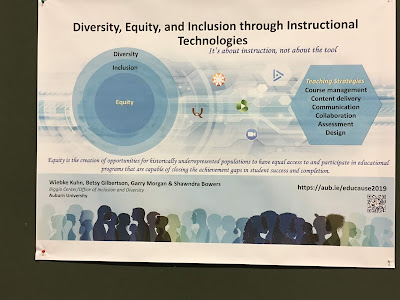
Other fun things during the conference: Betsy Gilbertson, Shawndra Bowers and I presented our Inclusion, Diversity, Equity and Information Technology poster, and we had lots of great discussions:
Instead, I learned a lot, networked even more, and encountered some new ideas:
1. In the pre-conference workshop focusing on active learning spaces, one of my key takeaways was the analysis what kind of teaching is happening when and for how long - and how attendance is only an issue in some of these types of teaching. This discussion, coming out of Australia, discussed the mapping of pedagogical constructs (prepare, connect, discover, activate, demonstrate, consolidate, extend) on to learning modalities (didactic, participative, facilitative, self-directed, supportive) over the course of the term.
The mapping broke down as follows, with the percentage being the amount of time throughout a term this may last:
Didactic - prepare
through activate - 15%
Participative -
connect through demonstrate - 20%
Facilitative connect
through consolidate - 25%
Self directed - discover through extend - 30%
Supportive -
demonstrate - through extend - 10%
The percentages
created the aha moment and showed that the first two created the attendance
issues - if students missed these, faculty were concerned, so focusing on these two parts as the times and spaces active learning strategies needed to be implemented to engage students, making it more likely for them to come to class made it easier for faculty to consider active learning (vs. the idea that the entire course needs to be redone).
Another key take-away were the square footage numbers that McGill is aiming for and what it has as a standard in its various classroom types:
ALC 22sf
Flat floor 19.66sf
Flat floor large
16.20sf
Lecture hall 15.86sf
Auditorium 12.72sf
Standard 25 sf
2. Steven Johnson's keynote focused on reframing the narrative of innovation away from a lonely genius inventor to the sense that innovation comes out of collaboration, in particular diverse collaboration. The terms he used were slow hunch - something that grows slowly over a long period of time, together with liquid networks - the people and networks that, in their diversity, change over time and bring different perspectives to the slow hunch.
The 18th century coffee house was his prime example of how this kind of liquid network has worked in the past. For more on his ideas, check out this TedTalk: https://www.ted.com/talks/steven_johnson_where_good_ideas_come_from?language=en
3. The Better Allies session was also quite meaningful, especially seeing quite a few of my Auburn colleagues in the room, which was heartening. Catlin focused on office housework, use of language, and how we need to protect our colleagues so that they are able to focus on productive work, not busy work. Definitely a book to read!
4. Tom Tobin's session on Universal Design for Learning brought home two points for me: We need to make sure that universal design for learning is not something that is seen by faculty as one more thing to do - rather, we need to encourage and teach everyone on campus what this is, why it is important, and how they can use it. And we need to make sure not to overwhelm everyone. Instead of insisting that multiple formats need to be used for folks to access content in multiple ways, let's focus on one more way. If I send something out as a text document, to make sure that it can be listened to. If I send out a video, to make sure that it has captions. Tobin also managed to capture the pre-conference attention by giving us a busy, nonsensical slide - quite a lot of fun!
Other fun things during the conference: Betsy Gilbertson, Shawndra Bowers and I presented our Inclusion, Diversity, Equity and Information Technology poster, and we had lots of great discussions:
Friday, November 1, 2019
Educause 2019 - Technology Finds
This year's Educause seemed to move even faster than previous ones - the venue was huge, many of the sessions very engaging, and with over 8,000 attendees, this was the largest gathering to date.
With this post, I want to highlight some of the technologies in the exhibit hall that caught my eye, even if only for a brief moment. I am not endorsing them; I am simply pointing out that they had some features that struck me as useful.
1 Beyond: https://1beyond.com/automate is a set of cameras that allow for a wide scope shot with one camera while tracking the speaker with a second camera. Facial recognition software allows for intelligent tracking.
GlyphEd for data visualization: https://www.glyphed.com/ This looked rather strange, and maybe that was the appealing part of it, but its visualization made it easy for someone like me to spot the anomaly, Of course, it may have also just been a very clear example for the sales pitch.
Steelcase may have done it again, creating a new collection, Flex collection - the wheel barrow approach strikes me as quite useful for maker spaces that need to be more flexible, and I was quite taken by their mobile whiteboard solution.
Techready.io: https://techready.io/ - a potential solution for ensuring that devices used by online students are ready for online courses, online exams, and online participation. This may be too intrusive, but could help with better information when students need technical help and don't know enough about the devices they are using.
Pronto - different messaging platform in Canvas: https://trypronto.com/ - not sure that it is a real improvement, but it was touted as working better on mobile devices.
Acadly - for attendance and student response systems - https://www.acadly.com/ - this system could make it easier and more reliable to take attendance in any size class. The system also makes it easier to track attendance of individual students, identifying students at risk, and it incorporates some polling, quizzes, Q&A and other features for student engagement.
Nearpod - student response system on steroids - nearpod.com - I watched a bit more of a demo for this one, and it has some intriguing features: a large library of 360 degree, high resolution photos of, for example, a hospital room, that students can explore on their own devices, 3D models that an be rotated and zoomed into; universal design for learning features making it easy to have text or audio available to students, and some other interesting student engagement features. As the instructor, you can also choose if you want to run the presentation synchronously or have it set for student-paced, which makes this easier to use for a complete online course.
With this post, I want to highlight some of the technologies in the exhibit hall that caught my eye, even if only for a brief moment. I am not endorsing them; I am simply pointing out that they had some features that struck me as useful.
1 Beyond: https://1beyond.com/automate is a set of cameras that allow for a wide scope shot with one camera while tracking the speaker with a second camera. Facial recognition software allows for intelligent tracking.
GlyphEd for data visualization: https://www.glyphed.com/ This looked rather strange, and maybe that was the appealing part of it, but its visualization made it easy for someone like me to spot the anomaly, Of course, it may have also just been a very clear example for the sales pitch.
Techready.io: https://techready.io/ - a potential solution for ensuring that devices used by online students are ready for online courses, online exams, and online participation. This may be too intrusive, but could help with better information when students need technical help and don't know enough about the devices they are using.
Pronto - different messaging platform in Canvas: https://trypronto.com/ - not sure that it is a real improvement, but it was touted as working better on mobile devices.
Acadly - for attendance and student response systems - https://www.acadly.com/ - this system could make it easier and more reliable to take attendance in any size class. The system also makes it easier to track attendance of individual students, identifying students at risk, and it incorporates some polling, quizzes, Q&A and other features for student engagement.
Nearpod - student response system on steroids - nearpod.com - I watched a bit more of a demo for this one, and it has some intriguing features: a large library of 360 degree, high resolution photos of, for example, a hospital room, that students can explore on their own devices, 3D models that an be rotated and zoomed into; universal design for learning features making it easy to have text or audio available to students, and some other interesting student engagement features. As the instructor, you can also choose if you want to run the presentation synchronously or have it set for student-paced, which makes this easier to use for a complete online course.
Monday, October 28, 2019
International Forum on Active Learning Classrooms
At this year's International Forum on Active Learning Classrooms in sunny Minneapolis/St. Paul, the focus of sessions was well balanced between how to accomplish certain administrative processes, implementations, technical issues and why we focus on active learning, evidenced through valuable research that shows the impact active learning has for student success. The following captures some of my key takeaways from three full days of presentations, workshops, posters, and networking.
Christina Petersen from the University of Minnesota discussed different practices to discern if students in small groups are indeed learning, adding accountability and moments of reflection for individual students and groups. Here are some key strategies she used

Colleagues from Florida International, Uma Swamy and Sonia Underwood, discussed how model building and simulations can make Chemistry more relevant and relatable for students. Their tools include balloons and gum drops for physical manipulation of molecular structures, but also online simulations. These models and simulations make it easier for more students to shift from a 2D model of thinking to a 3D model of thinking, vital to understanding chemical structures.
Julian Allen, Georgia State, discussed his research on exploring and overcoming instructor barriers to adopting active learning techniques. He learned that while faculty think that their students are resistant, it is really more the faculty themselves and their leadership that brings resistance to the table, partially explained by the perception that a space needs to be designed for active learning.
My colleagues Taffye Benson-Clayton and David Crisostomo made our session on inclusion, diversity, equity, and academic development towards active learning a big success. Together, we asked session members to explore IDE through the lenses of the teacher, the administrator, and student success. We saw quite a few aha moments, and we learned about using a word cloud app to make invisible diversity obvious to everyone in class.
Sarah Grace, University of Arizona, reported on her research that included classroom observations in active learning classrooms. Her observation tool is somewhat different from others we have seen, and relies on five-minute- chunks. She learned that while more women do active learning, they shift back to lecture after about 20 minutes. Having learning assistants is very important to keep going with active learning. Active learning also happens more during 1st year classes (towards the end of the class) than 4th year classes.
Michelle Rossi and Kem Saichaie, UC Davis, shared four practical strategies from the science of learning for some workshop ideas. Their handouts connect the theory from the science with the practical application (jigsaw) to give faculty the time to think about the science and how this may affect their classes. The four strategies are Retrieval Practice, Interleaving, Spaced Learning, and Explanatory Questioning or Elaborating Interrogation. Most interesting to me was that Michelle had used this activity as an icebreaker in her lab with undergraduate students, and they used this language throughout the term, even into the student evaluations.
Finally, Sue Wick from U of Minnesota gave us some moments of reflection about the conference, what we learned, its history, and future challenges of student mental health.
Christina Petersen from the University of Minnesota discussed different practices to discern if students in small groups are indeed learning, adding accountability and moments of reflection for individual students and groups. Here are some key strategies she used
- Noise level in class
- Instructor captures student contributions
- Provide specific and clear opportunities for individual students to check in with you
- Provide groups with a plan and elements that need to be covered to be successful in learning in group
- Ask for volunteers
- Call randomly on individuals (with random generator)
- Call on someone but give opportunity to check with table for 30 seconds before the cold call
- Cold call
- all groups participate by making choices (e.g., student response systems or simply paper)
Some of the issues with these are that random and cold calling can be problematic for introverts; however, research shows that cold calling does increase student voluntary participation - and student anxiety. Giving students extra time and allowing to check in with group members may help.
Wait until more hands are raised.
Tracey Birdwell from Indiana University showcased how they provide faculty with opportunities and ideas to come up with dream learning spaces
Derek Bruff from Vanderbilt, drawing on his new book Intentional Tech: Principles to Guide the Use of Educational Technology in College Teaching, led us into raising awareness what technology is the most important one - it was a draw between erasable surface and wheels, not too surprising in our group. He asked us to think about story telling and thin slices of learning (Randy Bass) as ways for students to get more engaged with the materials, create knowledge and artifacts. He reminded us that our task is to move novices towards expertise, which means we need to be agile teachers to make learning visible. He also reminded us that volunteer responses from students always come from the same type of students, always about 5-8 students, no matter the class size.
Elizabeth Lugosi, Math faculty at University of Arizona, showed research indicating how active learning in her Math courses had increased the A and B grades and decreased failure rate by 13.4%.
I learned here about pressbooks for the first time, and I saw them again at Educause - more to be explored. I had some great discussions around my own poster:

Colleagues from Florida International, Uma Swamy and Sonia Underwood, discussed how model building and simulations can make Chemistry more relevant and relatable for students. Their tools include balloons and gum drops for physical manipulation of molecular structures, but also online simulations. These models and simulations make it easier for more students to shift from a 2D model of thinking to a 3D model of thinking, vital to understanding chemical structures.
Julian Allen, Georgia State, discussed his research on exploring and overcoming instructor barriers to adopting active learning techniques. He learned that while faculty think that their students are resistant, it is really more the faculty themselves and their leadership that brings resistance to the table, partially explained by the perception that a space needs to be designed for active learning.
My colleagues Taffye Benson-Clayton and David Crisostomo made our session on inclusion, diversity, equity, and academic development towards active learning a big success. Together, we asked session members to explore IDE through the lenses of the teacher, the administrator, and student success. We saw quite a few aha moments, and we learned about using a word cloud app to make invisible diversity obvious to everyone in class.
Sarah Grace, University of Arizona, reported on her research that included classroom observations in active learning classrooms. Her observation tool is somewhat different from others we have seen, and relies on five-minute- chunks. She learned that while more women do active learning, they shift back to lecture after about 20 minutes. Having learning assistants is very important to keep going with active learning. Active learning also happens more during 1st year classes (towards the end of the class) than 4th year classes.
Michelle Rossi and Kem Saichaie, UC Davis, shared four practical strategies from the science of learning for some workshop ideas. Their handouts connect the theory from the science with the practical application (jigsaw) to give faculty the time to think about the science and how this may affect their classes. The four strategies are Retrieval Practice, Interleaving, Spaced Learning, and Explanatory Questioning or Elaborating Interrogation. Most interesting to me was that Michelle had used this activity as an icebreaker in her lab with undergraduate students, and they used this language throughout the term, even into the student evaluations.
Finally, Sue Wick from U of Minnesota gave us some moments of reflection about the conference, what we learned, its history, and future challenges of student mental health.
Thursday, October 24, 2019
Book: The Spark of Learning: Energizing the College Classroom with the Science of Emotion
Sarah Rose Cavanagh works through different dimensions of emotion and how they impact learning and therefore teaching and the classroom. Her big takeaway is to involve our students emotionally in order
for them to learn better and persist, stay motivated, and not give (too much) into negative emotions. She reminds us that emotion and
cognition are intertwined and connected in our brains (not in separate regions as
some folks believe), and that emotions are needed
to make quick decisions (think back to Kahneman's Thinking, Fast and Slow), so we as teachers need to be able to recognize student emotions, make sure we have tools to generate positive emotions and handle negative emotions.
If learning is
paired with positive emotions, students will believe they are more successful -
which may not lead to more learning but will lead to greater willingness to
stay engaged with content and that should lead to more learning. However, positive emotion
does not equal entertainment.
The following are some quick notes about each of the chapters, with a couple of resources:
- The science and neuroscience
of your emotions
emotions guide our thinking and cannot be separated out from what we consider rational - The Wellspring: emotions enhance learning
emotions connected to how well we focus (https://www.youtube.com/watch?v=vJG698U2Mvo)
emotions maximize working memory potential and memory consolidation: the more memorable the circumstance, the more likely you remember the content- surprise
emotional contagion: emotions can be contagious, affective crossover
Why we hold hands tedtalk: https://www.youtube.com/watch?v=1UMHUPPQ96c - Be the Spark. Craft your
first and lasting impression:. Active and enthusiastic. Take care of
yourself; be mindful and aware of yourself, emotionally authentic; humor
relevant to course, confidence and optimism, inclusive pronouns - we learn
together
Flook article Mind brain and education 7(3) 182-95 - Burning to Master: make your content relevant, engaging, creating curiosity and confusion, pushing students carefully out of their content comfort zones
- Fueling the Fire. Prolonging Student Persistence - give students some choices for their assignments as that kind of empowerment will give greater buy-in into their learning; goal setting are also important to foster growth mindset
- Best-Laid plans. When
emotions challenge or backfire. Negative emotions taking over because of
anxiety, esp on tests and other high stakes assignment - clarity,
transparency
power struggle - students want to not do the work, so will challenge esp when authority is perceived as not that strong - be transparent, respectful, engaged. Social loafing
Her conclusion highlights the key ideas (starting on page 212):
1. "Choosing activities, readings, and assignments that are interesting, self-relevant, emotionally evocative, and/or deeply relevant to the future careers of students may be the most powerful organizing principle you have as a teacher" (212).
Where do you see this in the classes you teach? Take a moment and identify three moments in your class where you are carefully building into the class these kinds of activities, readings, or assignments. What do you find?
2. "Practicing full transparency will yield benefits in motivation, heighten student perception of your supportiveness and honesty, decrease student anxiety, and alleviate psychological reactance" (213).
Think back to a moment where your transparency helped your students relax into the content, learn better, and engage more fully with potentially adverse or difficult ideas and concepts.
3. "Teaching is a performance profession, so hone your performance: transmit confidence, curiosity, optimism, and immediacy in your verbal and nonverbal performance" (213).
How do you practice performance? Do you stand in front of the mirror for practice? Do you mark in your lesson plan moments of performance? Do you reflect on your course and identify moments of performance?
Thursday, August 29, 2019
Book: How Humans Learn: The Science and Stories Behind Effective College Teaching
In Curiosity, he reminds us that from day 1 of our lives, we are curious about things - if something is different than we expect, we will spend more time on it; if we get something in detail explained to us, we spend less time exploring it (and thus learning less). Novelty sparks curiosity but can also create stress and anxiety, counteracting any kind of learning. This means that for instruction, we need to find essential or mega questions to guide our students' learning - and we need to give them space and practice to develop their own questions.
One way to start sparking curiosity in class is to ask what do you notice, what do you wonder about.
Curiosity tends to be something an individual develops, but Sociality is the dimension that connects us with others. Humans are one of a few species where large groups take care of the immature - being social is essential to us, in isolation we become sick. Humans learn through imitation (here is where mirror neurons in our brain come into play), and communication is the next step in imitation.
One interesting point here is that the mother-infant language has been undervalued in its role of language development as women have not been seen as "evolutionary movers." But this understanding appears to be shifting. Other social activities that humans learn through are play, story telling, and modeling. Bandura's modeling theory and Vygotsky's zone of proximal development show why these ways of interacting create learning opportunities.
For instructors this means that we need to create a positive learning environment, a sense of belonging and community in our classes for all of our students. Modeling not only assignment but behavior is also important to move students from novice to expert in our fields - whether this is modeling how to conduct an experiment, modeling how to cite a paper, or modeling how to make a mistake and learn from it, all of these are essential to giving our students the chance to learn and grow in the higher education learning environment.
Eyler's next major concept is Emotion. Emotion ties directly into us being part of a group (Sociality) and being curious (Curiosity), as positive emotion allows us to participate more fully and allow us to think more effectively. While a negative emotion can be helpful to learning up to a certain point (consider the stress of a deadline that may help us focus, or, even more importantly, pushing ourselves out of our comfort zones to learn something new), too much negative emotion triggers fight or flight behavior and our survival instinct kicks in, essentially cutting off the blood flow to our brain. Emotions are also connected to memories, and as we build on our existing learning based in memories, the more we can emotion connect to learning, the more memories are formed, the more connections are created and learning occurs.
None of this means that we as instructors need to be come entertainers to create a happy environment. Instead, as Eyler suggests, it means that we show the relevance of the material to the students so that they see why they are learning content and skills - this in itself creates satisfaction and happiness, though joy may be a better word. Showing our enthusiasm and passion for the subject area will also trigger joy in the students as we create a social system of learners, and finally, caring for our students to help them be successful will also create positive emotions. Eyler quotes Nel Noddings, reminding us that "the student is infinitely more important than the subject matter."
Authenticity connects back into showing our enthusiasm and passion and making the material relevant to students. Research shows that a lack of authenticity leads to short attention spans. Long lectures do not tend to be authentic for the students, so the lose focus and do not learn. Providing authentic learning experiences, instead, will give students the chance to practice, and learn from mistakes. This leads to the final concept:
Failure - mistakes are essential for learning, but in a high stakes environment like the university, convincing students of this is difficult. Giving them low-stakes opportunities for making mistakes and learning from them is key; faculty need to remember to be transparent about this process as students have a hard time differentiating between high and low stakes assignments. This transparency can also include more of a discussion on how we learn - that we tend to jump to conclusions without reflection because of habits, that we need to remind ourselves to slow down and think, and that we learn best when our expectations are violated.
But this kind of productive failure also needs to be set in a positive learning environment. If the basic needs of food, rest, hydration, and safety are not met, learning will not happen. Giving students safe spaces to learn is essential -- for all students. Giving students the support network to learn to just keep going and try one more time is also important - for all students. Not giving students grades may be one way to create such an environment. Giving students space to learn skills and content that we think they should already know but, for some circumstance, have not learned yet or did learn but are not recognizing as applying in our learning context is another strategy.
Eyler's next major concept is Emotion. Emotion ties directly into us being part of a group (Sociality) and being curious (Curiosity), as positive emotion allows us to participate more fully and allow us to think more effectively. While a negative emotion can be helpful to learning up to a certain point (consider the stress of a deadline that may help us focus, or, even more importantly, pushing ourselves out of our comfort zones to learn something new), too much negative emotion triggers fight or flight behavior and our survival instinct kicks in, essentially cutting off the blood flow to our brain. Emotions are also connected to memories, and as we build on our existing learning based in memories, the more we can emotion connect to learning, the more memories are formed, the more connections are created and learning occurs.
None of this means that we as instructors need to be come entertainers to create a happy environment. Instead, as Eyler suggests, it means that we show the relevance of the material to the students so that they see why they are learning content and skills - this in itself creates satisfaction and happiness, though joy may be a better word. Showing our enthusiasm and passion for the subject area will also trigger joy in the students as we create a social system of learners, and finally, caring for our students to help them be successful will also create positive emotions. Eyler quotes Nel Noddings, reminding us that "the student is infinitely more important than the subject matter."
Authenticity connects back into showing our enthusiasm and passion and making the material relevant to students. Research shows that a lack of authenticity leads to short attention spans. Long lectures do not tend to be authentic for the students, so the lose focus and do not learn. Providing authentic learning experiences, instead, will give students the chance to practice, and learn from mistakes. This leads to the final concept:
Failure - mistakes are essential for learning, but in a high stakes environment like the university, convincing students of this is difficult. Giving them low-stakes opportunities for making mistakes and learning from them is key; faculty need to remember to be transparent about this process as students have a hard time differentiating between high and low stakes assignments. This transparency can also include more of a discussion on how we learn - that we tend to jump to conclusions without reflection because of habits, that we need to remind ourselves to slow down and think, and that we learn best when our expectations are violated.
But this kind of productive failure also needs to be set in a positive learning environment. If the basic needs of food, rest, hydration, and safety are not met, learning will not happen. Giving students safe spaces to learn is essential -- for all students. Giving students the support network to learn to just keep going and try one more time is also important - for all students. Not giving students grades may be one way to create such an environment. Giving students space to learn skills and content that we think they should already know but, for some circumstance, have not learned yet or did learn but are not recognizing as applying in our learning context is another strategy.
Subscribe to:
Posts (Atom)